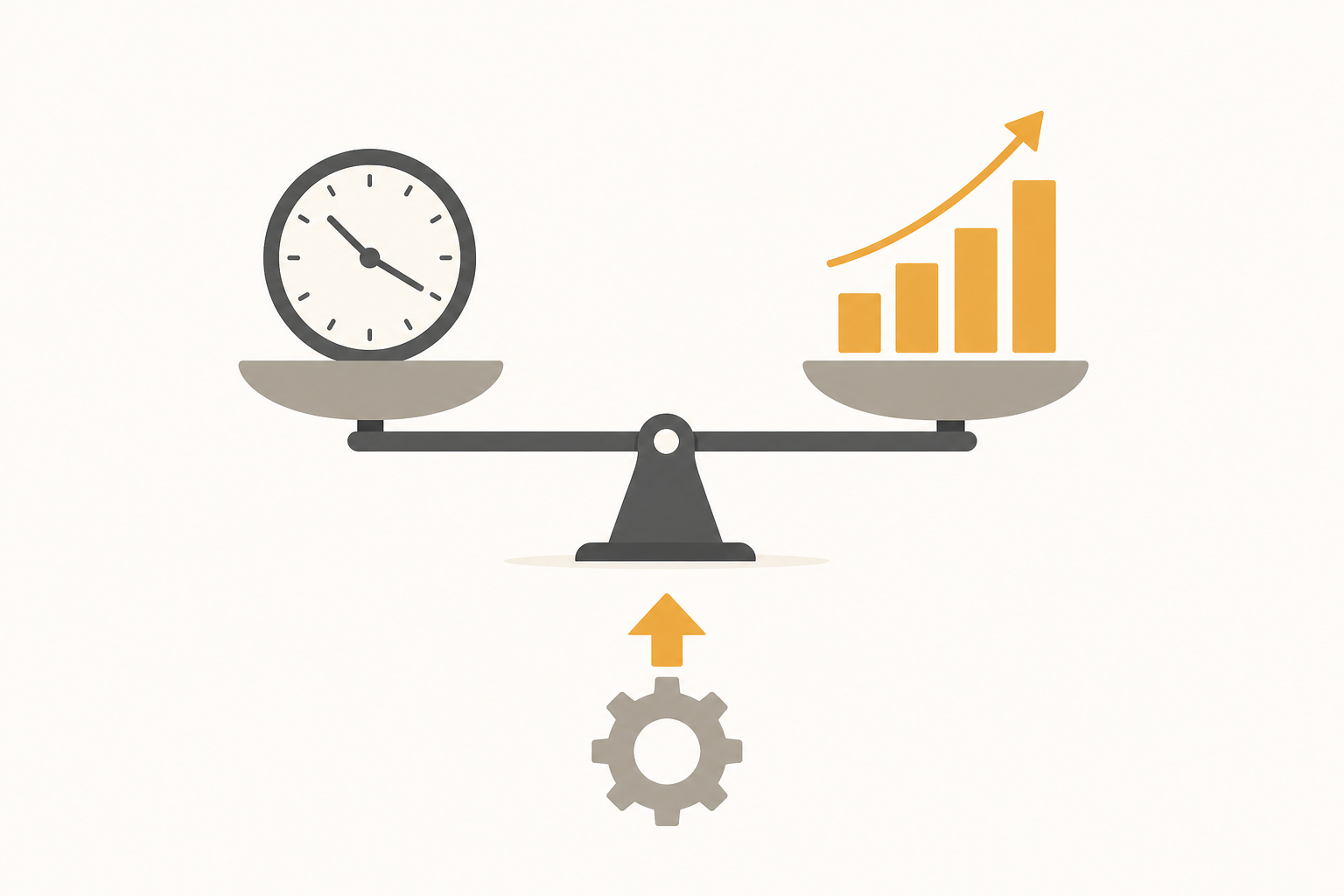
Most AI automation advice is written by people who have not actually built any. It reads like a list of things you could theoretically automate. This post is different: it covers what I built for real businesses over the last year, what the ROI calculation actually looked like, and two cases where the automation did not pay off and why.
What worked
1. Automated lead capture and follow-up
This is the highest-ROI automation I have built, and I have built it in different forms for multiple businesses. The pattern: a visitor contacts you, the system sends an immediate personalised response, adds them to a follow-up sequence, and creates a CRM entry. No one checks an email and replies manually.
The numbers that make this worth it: for a service business where each client is worth $300 to $1,000, missing one lead per week because of a slow reply represents $15,000 to $50,000 in lost revenue per year. The automation costs $2,000 to $5,000 to build and runs for free after that.
For OliviaGRE specifically: the automated funnel captures roughly 40 new email subscribers per week via forms and the chatbot. The email automation sequences run at 75% open rate. The system runs 24/7, including times when nobody is available to respond manually.
2. Pulling multiple data sources into one weekly report
Before building an automated report for OliviaGRE, the weekly review meant logging into Stripe, YouTube Studio, Google Analytics, and MailerLite separately, then copying numbers into a spreadsheet. About 45 minutes every Monday.
After: a script runs automatically, pulls from all four APIs, and generates a structured report with analysis and recommendations. The 45 minutes is replaced by a 5-minute read. More importantly, the report surfaces things that manual review missed, like the email sequence with a 43% open rate but only 2% click rate, which indicates weak CTAs rather than weak subject lines.
3. Context-specific AI that knows your actual business
A generic chatbot answering "what are your services" is marginally useful. An AI that has been trained on your specific customers, products, and objections is genuinely different.
DialCoach's call coaching AI is an example of this. It does not give generic sales advice. It grades calls against the specific methodology that team uses, references timestamps from the actual call, and connects feedback to the rep's cross-call coaching plan. The difference in usefulness between a generic "AI sales coach" and one grounded in the team's actual calls is substantial.
The OliviaGRE chatbot is another version. It answers questions about the GRE, not general education questions. It knows the specific study plan that gets downloaded, the specific trial lesson that gets offered, and the specific objections GRE students raise. That specificity is what produces a 75% email capture rate from conversations rather than the 20 to 30% you get from a generic bot.
What did not work
1. Content automation that was not a business bottleneck
I spent several weeks building a content automation system that produced branded short-form videos on a schedule: pulling data from the business, formatting it, generating a script, rendering a video, posting it. Technically it worked. The client was not at the stage where content volume was their constraint. They needed more leads first, and more leads would have come from the lead funnel, not from posting more content. The automation sat largely unused for months.
The lesson: automation ROI depends on whether you are automating something that is actually the bottleneck. Content automation helps a business that is already getting traction from content and wants to scale it. It does not help a business that has not yet figured out what content works.
2. Chatbots without a defined job
"Add a chatbot to the website" is not a brief. Every chatbot I have seen fail had this in common: the owner wanted a chatbot because they had heard chatbots were useful, not because they had a specific problem the chatbot was meant to solve.
A chatbot with a clear job, like "reduce the number of DMs asking what sessions cost" or "capture emails from YouTube traffic that lands on the homepage," performs well because you can measure it and tune it. A chatbot with no defined job becomes a FAQ page that nobody uses.
The pattern that separates AI automations with ROI from ones without: the automation removes something that happens constantly. Lead follow-up happens every time someone contacts you. Weekly reporting happens every Monday. Those are constant, repetitive processes. Content creation for a business still finding product-market fit is not constant in the same way.
The ROI test I run before building anything
Before starting an automation project, I ask three questions:
- How often does this task happen? Automation only makes financial sense for things that occur repeatedly. Something that happens once a week is worth automating. Something that happens once a month probably is not.
- What does it cost when it happens manually? Either in time (hourly rate times hours) or in missed revenue (leads not followed up, reports not read).
- Is this the actual bottleneck? Automating a process that is not limiting growth does not produce growth. Identify what is actually slowing the business down, then automate that.
- Lead capture and instant follow-up (highest ROI, hardest to justify not doing)
- Booking reminders and no-show reduction (saves 10 to 15% of appointment revenue)
- Payment and invoice follow-up (removes the awkward chasing)
- Weekly data report from existing tools you already use
- Context-specific chatbot for a specific, high-volume question
Frequently asked questions
Want to find the automation with the highest ROI for your business?
Book a free call. I will ask three questions and tell you honestly whether automation is worth it for your situation, and what to build first if it is.
Book a Free Call →