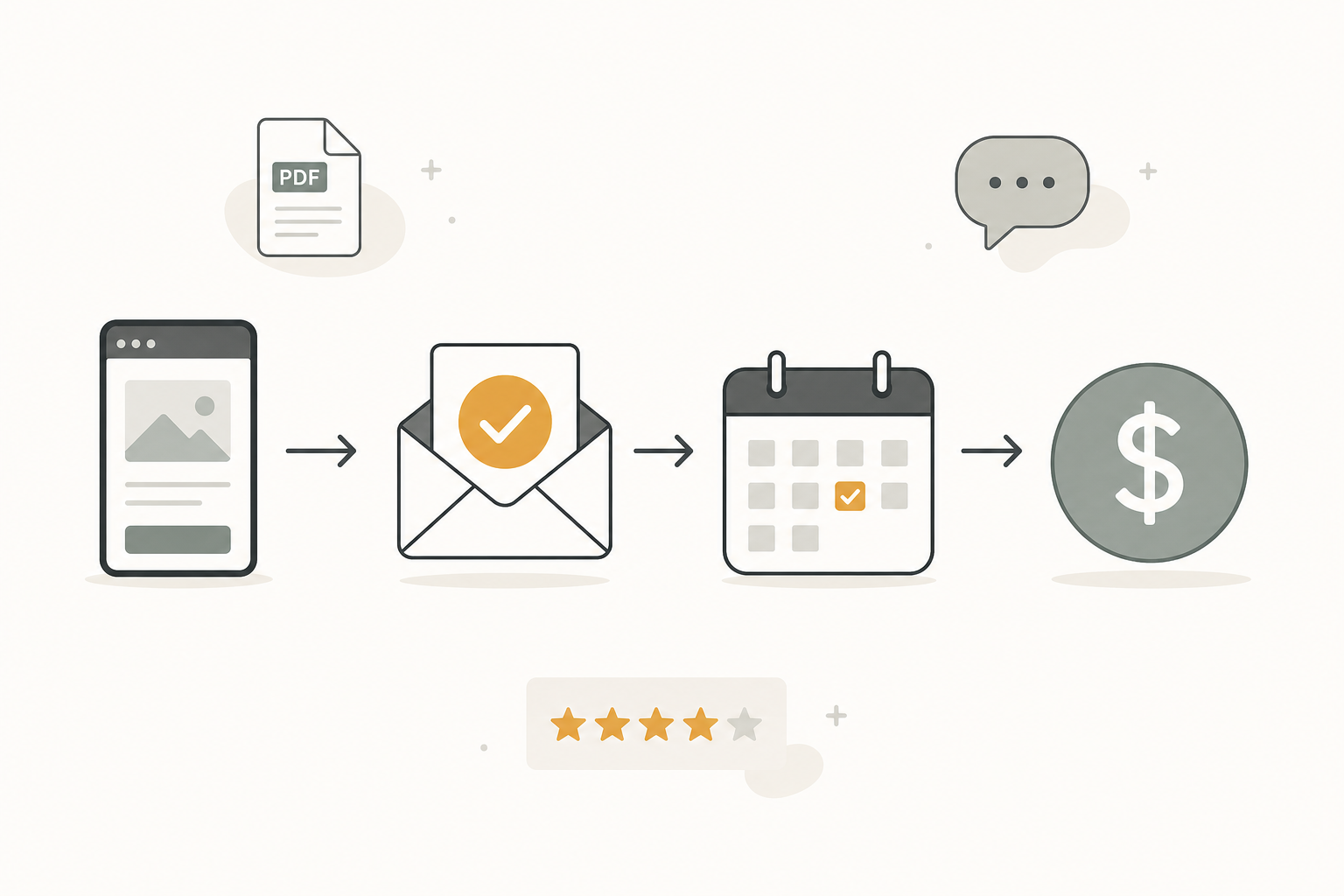
Most coaching businesses handle leads the same way. Someone fills out a form, the owner gets an email, the owner manually replies (maybe the same day, maybe a week later), and hopefully books a call. It works until it does not, and then leads quietly disappear.
OliviaGRE is a GRE tutoring business run by Olivia, a tutor who helps students prepare for graduate school admissions. GRE prep is a competitive, high-intent market. Students are actively searching for help, they have a deadline, and they will book with whoever responds first. That made the lead response problem especially expensive to ignore.
I built an automated funnel that handles everything from first contact to paid booking without anyone doing anything manually. Here is how it works and the numbers from about six months of it running.
How the funnel actually works
Most of the traffic comes from YouTube, where Olivia posts GRE vocabulary and strategy content. Someone watches a video, clicks through to the site, and lands on a homepage with a chatbot and a free lead magnet (a GRE study plan PDF). That lead magnet is where most email addresses come from.
What this replaced
Before this system, the workflow was manual at every step. Check email, find the inquiry, reply, send a calendar link, chase people who did not book, note whether they showed up, log payments by hand. Probably 3 to 4 hours a week at modest volume.
The bigger problem was not the time. It was the inconsistency. A lead that arrived on a Saturday afternoon might wait until Monday for a reply. By then the student had booked with someone else.
The most useful thing this system does is not save time. It removes the dependency on the owner's availability. A lead at 2am on a Sunday gets the same response as one on a Tuesday afternoon.
What it costs to build and run
The tool costs at this volume are essentially zero. Netlify, Google Sheets, MailerLite, and the calendar tool all have free tiers that cover a business doing under a thousand leads per month. Stripe takes a percentage of transactions only when money moves.
The build took a few weeks of part-time work over a couple of months. The trickiest part was not any individual piece but making everything talk to each other reliably and tracking which channel each lead came from. Attribution sounds straightforward and is not.
What does not work automatically
The system cannot close. Once someone books a trial lesson, the quality of that session determines whether they buy a package. A great call converts. A weak one does not. The CRM tracks the outcome but has no influence over it.
The longer nurture sequence (29 emails for subscribers who do not book quickly) has a 43.6% open rate but only a 2.2% click rate. People are reading but not acting. That is an email content problem. The calls to action in those emails are not compelling enough. Fixing that is human work.
- Netlify serverless functions (no server to maintain)
- Google Sheets as the CRM (flexible, free, accessible to the whole team)
- MailerLite for email sequences
- Cal.com for bookings and no-show tracking
- Stripe for payments
- Custom chatbot built on the Claude API
Frequently asked questions
Want a lead funnel like this for your business?
I build these systems for service businesses and coaches. Book a free call to see what makes sense for your setup.
Book a Free Call →