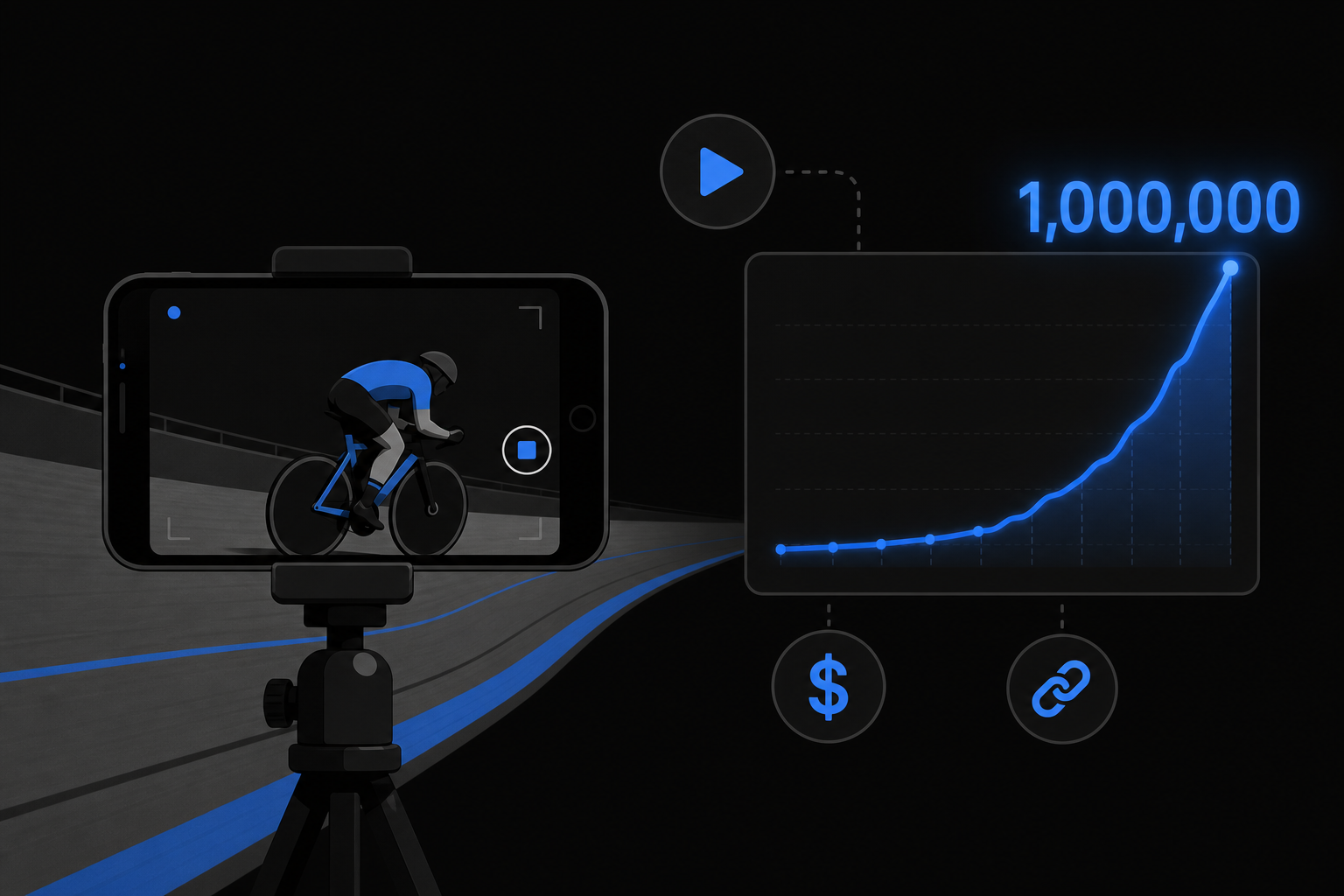
My cycling channel, @JacksCoaching, hit 1 million views in under 12 months. I started it with an iPhone, no equipment, no editing software, and no strategy beyond filming gear I was already buying. It now generates passive income through affiliate commissions while I am not working.
This post breaks down exactly how I grew a YouTube channel from zero to 1 million views: the YouTube Shorts strategy that drove most of the reach, the content formula that separates high-view videos from invisible ones, and the affiliate marketing system that turns old videos into ongoing passive income.
YouTube Shorts were the primary growth engine
YouTube Shorts now receive over 70 billion daily views globally. For a new channel with zero subscribers, Shorts are the fastest path to reach because the algorithm evaluates each Short independently. You do not need an existing audience. You need a Short that people watch to the end.
The metric that matters most for YouTube Shorts growth is watch-through rate: the percentage of viewers who watch your Short all the way to the end. A high watch-through rate signals to YouTube that your content is worth showing to more people. A high swipe-away rate in the first two seconds kills distribution immediately.
My most-viewed Short, at 329,000 views, is 27 seconds long. I swapped bikes with someone on a $16,000 Specialized Tarmac SL7 at the velodrome. He rode my $3,000 AliExpress build and said it felt fast. That is the entire video. No fancy camera. No editing. The watch-through rate was high because the premise is surprising and the payoff comes in the last five seconds.
The YouTube Shorts algorithm does not reward production quality. It rewards watch-through rate. A punchy 20-second Short with a clear hook and a satisfying payoff outperforms a technically polished Short that loses viewers halfway through.
The content formula behind high-view videos
Looking across the channel, every video that crossed 50,000 views shares the same underlying structure. Understanding this pattern is the most useful thing you can take from this post.
1. A contrarian angle with a specific claim
"My $3K Chinese bike felt faster than his $16K Tarmac" works as a hook because it challenges the assumption that expensive bikes are better. "4 better upgrades than Dura-Ace" works for the same reason. The viewer's immediate reaction is skepticism, which creates enough tension to keep watching.
Generic titles perform poorly. "Road bike review" has no tension. "Is this $2,500 bike the Tarmac killer?" has tension. The contrarian angle is not about being clickbait. It is about having a specific, defensible point of view that the viewer cannot predict in advance.
2. Buying-intent keyword research before filming
The videos that generate affiliate income long-term are the ones built around buying-intent keywords: searches where the viewer is close to making a purchase decision. On YouTube, these follow predictable patterns: "[product] review", "[product] vs [product]", "best [product] under $X", "is [product] worth it".
Before filming a review, I now check YouTube autocomplete and vidIQ to see whether people are actually searching for that product. "AliExpress saddle review" has real search volume. "Chinese carbon saddle test" does not. One of those videos keeps getting traffic 12 months later. The other was watched once and forgotten.
3. Authentic specificity over polished generics
The crash video where I filmed the CCTV footage of my bike being stolen: 2,953 views. Not high, but it drove real engagement and watch time because it is specific and true. "Bike safety tips" would get ignored. "My bike got stolen while I was inside a shop for 60 seconds" gets watched.
Specific true stories convert better than general advice. This applies to every niche, not just cycling gear.
How YouTube affiliate marketing generates passive income
AdSense revenue on a cycling channel at this scale is small. A few dollars per video per month. The affiliate income is where the real passive income opportunity is.
The model is straightforward: review a product honestly, add an affiliate link in the description, earn a commission when viewers click through and buy. A product review you upload today can still be driving affiliate clicks in 18 months if it ranks in YouTube search and Google search for the relevant keywords.
- Evergreen review videos keep ranking in YouTube search long after upload
- YouTube videos increasingly appear in Google search results and AI Overviews, giving each video multiple discovery paths
- A buyer searching "AliExpress carbon saddle review" six months from now will find your video if it is keyword-optimized
- Brand partnership offers (TanTan reached out to sponsor the channel) arrive inbound once you have ranking content
- One piece of long-form content generates multiple Shorts, extending the reach of each affiliate link
VidIQ's data shows that channels with 10,000 monthly views on affiliate content can realistically earn $200 to $800 per month from affiliate commissions alone, depending on niche and product price point. At 100,000 monthly views, that range becomes $2,000 to $8,000. The CPM from AdSense on Shorts is low. The affiliate income scales with the quality of the content and the buying intent of the audience.
The practical playbook for growing a YouTube channel from zero
Here is the exact approach I would take if I were starting the channel today, informed by what actually drove growth versus what wasted time.
- Pick a niche where you have a genuine contrarian angle. Not "cycling tips" but "budget gear that performs like expensive gear." Not "small business advice" but "what AI automation actually worked vs. what wasted time." The angle needs to be specific and defensible.
- Do keyword research before filming, every time. Check YouTube autocomplete for your topic. Look at what high-performing videos in the niche are ranking for. Build your title and description around a specific buying-intent keyword before you touch the camera.
- Publish before you are ready. The first video I uploaded was shot at night on an iPhone with no lighting. It got 14,000 views. It validated the angle. If I had waited until the channel looked professional, I would have been waiting for months with no data.
- Hook in the first two seconds, pay off before the end. For Shorts, the first two seconds determine whether YouTube distributes your video broadly or quietly kills it. The payoff (the surprising fact, the plot twist, the answer) should arrive before the viewer has time to swipe away.
- Add affiliate links to every product you mention. Even at 200 views, the links are working. Compound interest on content starts from day one.
- Study your audience retention graphs weekly. YouTube Analytics shows you exactly where viewers drop off. That data tells you more about what to fix than any content strategy article ever will.
- Go 70% evergreen, 30% trend-responsive. Evergreen content (reviews, comparisons, tutorials) builds a library that earns for years. Trend content (new product drops, reactions) captures spikes but does not compound. Build the library first.
I build content systems and AI automations for small businesses and brands. If you want a system that compounds like this for your business, let's talk.
Book a Free Call →What this means for any brand building content
The cycling channel is a useful case study because it was entirely organic, with no paid promotion, no existing audience, and no professional equipment. The only advantages were a specific angle and genuine interest in the subject.
The channels and accounts that build real audiences are almost always built by people with a point of view, not people who decided "I should make content" and then searched for a topic. Authentic specificity is the variable that separates a channel that compounds from one that flatlines at 200 views per video.
The other transferable lesson is about speed. Publish first. Iterate based on data. A million views is a round number that sounds impressive. The more useful milestone was 14,000 views on a phone video filmed in bad lighting, because that was the moment I knew the angle was right. Everything after that was refinement.
Frequently asked questions
Want to build a content system for your business?
I build content systems and AI automations that compound over time. Book a free call to see what makes sense for your situation.
Book a Free Call →